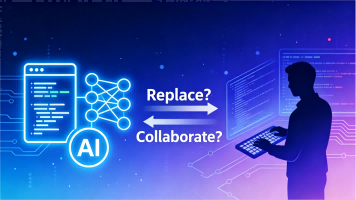
For the past two years, the debate over the fate of programmers has been dominated by two camps. One insists that code is being “eaten” by large language models, and that the programming profession will soon be automated the way assembly-line work once was. The other is more sanguine, framing AI as merely the next generation of IDE—liberating programmers from drudgery while leaving the industry essentially intact.
Both readings grasp part of the truth, but neither is complete. The real question is not “will programmers disappear?” It is: as AI coding tools keep getting stronger, how will the profession re-stratify internally? Which roles will come under pressure first? Which skills will be repriced? And will the industry see a net “wave of unemployment”?
If you follow the sentiment, the answer slides toward extremes. If you return to the data, the conclusion is more measured—and more sobering. The sturdier read is this: in the short to medium term, programmers are more likely to live through a structural reallocation than a wholesale collapse of the profession. But if education, hiring, and internal training mechanisms fail to adjust in time, certain cohorts—especially entry-level roles—could well suffer a genuine employment chill first.
I. AI Is Raising the “Ceiling of Substitution”—Let’s Not Pretend Otherwise
Start with the technology. When people used to talk about automation, they meant tasks that were rule-bound and highly repetitive. Today’s large models are different: they have begun entering knowledge-work territory—document drafting, code generation, test completion, requirement decomposition, troubleshooting. In other words, parts of the work programmers once relied on to build their professional moat are no longer automatically safe.
The World Economic Forum’s Future of Jobs Report 2025 is blunt: by 2030, structural labor transformation will affect 22% of current jobs, creating 170 million roles while displacing 92 million, for a net gain of roughly 78 million. That conclusion tells us two things. First, displacement is real. Second, displacement does not automatically equal net unemployment. Notably, the report also finds that 40% of employers plan to reduce headcount in areas where AI can automate tasks, while 70% plan to hire people with new skills, and 50% plan to move workers from declining to growing roles.
In other words, companies are not simply “firing everyone.” They are recomposing the division of labor between humans and machines. The catch is that this recomposition will not be evenly distributed. What gets compressed first is rarely the top engineers; it tends to be roles whose work is highly standardized, decomposable into workflows, and whose holders have the least bargaining power. Pure CRUD development, repetitive testing, low-complexity script maintenance, and entry-level outsourcing delivery are far easier to squeeze than high-complexity architecture design, cross-system coordination, and core business abstraction.
So: saying AI won’t touch programmers is glib. Saying programmers will vanish wholesale is equally unsupported by the evidence so far.
II. What Actually Drives Employer Decisions Isn’t Whether the Model Can Write Code—It’s Whether It Lowers Labor Costs
Companies don’t decide on layoffs by watching demo videos; they decide by looking at cost structure. The reason AI coding tools have produced genuine anxiety among programmers is that they are beginning to change the core question of “how many people does the same output require.”
Academic research has produced fairly clear micro-level evidence. A 2023 Science experiment ran an incentivized writing task with 453 college-educated professionals. Those using ChatGPT finished 40% faster and produced output 18% higher in quality, with the weakest performers benefiting the most. NBER’s Generative AI at Work, drawing on real work data from 5,179 customer service agents, found that introducing generative AI assistance lifted average productivity by about 14%—with newcomers and low-skill workers gaining as much as 34%—while customer satisfaction and retention improved too.
These studies aren’t about programmers directly, but they surface a crucial mechanism: generative AI first changes not “whether there is a human,” but “whether an ordinary employee can reach near-top-performer output in less time.” Once that mechanism keeps holding in programming, companies will reassess team size, job tiers, and training cycles.
This is the real source of programmer unease. The reason a team historically needed many mid- and junior-level engineers was that coding, integration, scaffolding, unit tests, documentation, debugging, and regression were genuinely time- and labor-intensive. Now, if a senior engineer paired with high-quality AI tools can cover part of what used to take two or three people, companies will naturally tighten the hiring funnel, raise the bar for “plug-and-play,” and lower their tolerance for low-experience roles.
In other words, what AI hits first is unlikely to be “the strongest incumbents”—it’s far more likely to be “the weakest entry point.”
III. So the Real Danger Isn’t the Disappearance of Programming Jobs—It’s the Narrowing of the Career Path
This is what most current discussions miss. A macro-level unemployment wave may not appear, but a micro-level break in the career ladder can.
The WEF data shows that by 2030, 59% of workers will need training; 29% can upskill in their current roles, 19% can move to new roles within their organizations, but 11% are considered unlikely to access the reskilling they need and will face higher employment risk. That number matters more for programmers than for most, because software has always depended on a “start at the bottom” growth model. A newcomer doesn’t begin by doing architecture or complex systems; they build up experience through large volumes of low-risk, low-complexity tasks.
If those low-floor tasks get absorbed by AI and companies refuse to pay for the training cycle, the industry may keep posting openings for “senior engineers,” “AI engineers,” and “full-stack engineers” while quietly pulling away the ladder for newcomers. Employment pressure then surfaces in a stealthier form: not all programmers are unemployed, but more people can’t get in, those who stay are squeezed harder, and teams demand ever-higher experience density.
This is also why many people feel “I don’t see mass layoffs around me, but finding a job is clearly harder.” The problem doesn’t necessarily show up in the headline unemployment rate; it shows up in job structure, hiring thresholds, and the half-life of skills.
IV. In Aggregate, Programmers Aren’t Facing “Extinction”; Structurally, the Industry Is Being Repriced
Looking at international data, the more persuasive conclusion remains “displacement and creation coexist.” The WEF lists software and application developers among the faster-growing roles in coming years. Stanford HAI’s 2025 AI Index Report notes that 78% of organizations reported using AI in 2024, up from 55% the year before, with a growing body of research showing AI boosting productivity and narrowing certain skill gaps in most scenarios. Goldman Sachs’ earlier work estimated that generative AI could lift global GDP by about 7% over a decade and raise labor productivity.
Taken together, these judgments show that AI is not a one-dimensional “job destroyer.” It displaces certain tasks while expanding new demand: model integration, data governance, AI safety, workflow orchestration, business-system refactoring, inference-cost optimization, compute and infrastructure management, human–AI product design. These are creating new roles and new combinations of skills. The real question isn’t whether there will be work, but where the work comes from, who it goes to, and what capabilities it takes to do it.
This is the deepest shift in today’s programmer market: the market no longer pays simply for “can you write code.” It pays for “can you fold AI into production systems, understand business constraints, and deliver end-to-end on complex problems.” Future wage premia will more likely flow to people who can harness AI, organize processes, and define problems—not to those who merely complete local coding tasks.
So the locus of competition is shifting from “code volume” to “problem-solving density.” Writing code itself will get cheaper; defining problems, validating solutions, controlling risk, and owning outcomes will get more expensive.
V. In the Chinese Context, the Risk Won’t Be Absent—But It Will Likely Play Out as a “Slow Variable”
Place this in the Chinese context and you can’t simply copy the Silicon Valley narrative. China’s software industry has long been visibly stratified: on one end, platforms, foundation models, chips, cloud infrastructure, and core business systems; on the other, a large volume of delivery-based, outsourcing, and project-based roles. AI affects these two ends differently.
For top teams, AI acts more like an amplifier—raising R&D efficiency, compressing repetitive labor, and accelerating prototyping and iteration. For the many homogeneous, standardized, thin-margin roles, AI acts more like a price-war tool, further intensifying the pressure to substitute labor. Meanwhile, official data from the National Bureau of Statistics still reflects the macro employment and economic picture, and won’t necessarily capture the warmth or chill in programmer sub-segments in real time. So what’s more likely in China is not a sudden “programmer unemployment wave” narrative, but a far more drawn-out raising of thresholds, wage polarization, and role bifurcation.
In one sentence: it’s not that all programmers will be out of work; it’s that ordinary programmers will find it harder to earn a decent living on “ordinary skills” alone.
VI. What We Really Need to Guard Against Are Three Illusions
The first illusion is equating task exposure with job disappearance. The fact that 30%, 50%, or more of the tasks in a profession can be affected by AI does not mean the role will vanish in lockstep—because organizational structure, division of responsibility, regulation, and business complexity all constrain how far automation can actually land.
The second illusion is equating productivity gains automatically with job losses. Historically, many technological advances first lifted efficiency, then created new demand by lowering costs, expanding supply, and spawning new products. AI may well follow the same pattern—just with uneven distribution.
The third illusion is watching layoff headlines from big tech while ignoring skill restructuring. What truly determines career prospects today isn’t only whether your company lays people off; it’s what capabilities the market actually rewards. If programmers still understand themselves as “code executors,” AI becomes a threat. If they elevate themselves into “system-level problem solvers,” AI becomes a lever on their abilities.
Conclusion: Not a Tidy Wave of Unemployment—But a Ruthless Repricing of the Profession
So: will programmers see mass layoffs, an unemployment wave? My judgment is that, at least in the visible short to medium term, what’s more likely is structural reallocation rather than a wholesale collapse of the profession. The industry’s total headcount may not cave in overnight, but job structure, capability requirements, compensation systems, and career entry points are already being deeply rewritten by AI.
Those hit first are unlikely to be the most senior engineers; they’ll be the people whose work is highly templated and who lack business understanding and systems thinking. Those who feel the chill first are unlikely to be established practitioners; they’ll more likely be newcomers just entering the field, developers stuck in low-value-add links of the chain, and organizations accustomed to trading hours for value.
In that sense, AI may not manufacture a neat, uniform “programmer unemployment wave,” but it is very likely to manufacture a longer, more polarized, and more ruthless repricing of the profession. The core asset of a programmer used to be “knowing how to write code.” The scarcer asset going forward will be: understanding real-world problems, reconstructing workflows with AI, and delivering outcomes under complex constraints.
What decides a programmer’s fate, in the end, is not whether AI can write code. It’s who can turn AI into their own productivity—and who gets repriced by it.
References
- World Economic Forum, The Future of Jobs Report 2025.
- Stanford HAI, AI Index Report 2025.
- Shakked Noy, Whitney Zhang, “Experimental evidence on the productivity effects of generative artificial intelligence,” Science, 2023.
- Erik Brynjolfsson, Danielle Li, Lindsey R. Raymond, Generative AI at Work, NBER Working Paper No. 31161.
- Goldman Sachs Research, “Generative AI could raise global GDP by 7%,” 2023.
- OECD Employment materials and Employment Outlook 2025.
- IMF World Economic Outlook 2024–2026 updates.