For decades, software engineering has run on an unwritten bargain: fix a bug, and you’re forced to understand a piece of the system; understand that piece, and the next failure gets easier to trace. The fix is what you pay; the understanding is what you get back. The exchange completes itself quietly in every debugging session, and it has never once failed. It is how new engineers grow up, how veterans stay sharp, and how teams remember why their systems are the way they are.
But the bargain rests on one assumption: the one doing the fixing has to be a person. For as long as anyone can remember, the only way to truly fix a bug was to understand the system it lived in.
AI has broken that assumption. It can fix your system without anyone, at any point, understanding anything.
So “fixing” and “understanding” — partners bound together for decades — are coming apart. Code as a liability was about our repositories hollowing out; this piece is about something that cuts deeper: the people are hollowing out too.
1. Why debugging is the best teacher you’ll ever have
Most people think of debugging as error-hunting and of a fix as “making the tests go green.” That’s the outcome, not the value. The real value is in the process: debugging is reading with questions in hand.
Reading code the usual way means walking the author’s path once and settling for knowing what it does. Debugging won’t let you settle. The system didn’t do what you expected, so you have to guess at causes, hunt for evidence, and test your hunches — you get pushed all the way down to why it is the way it is. Why did this function receive this argument? Why did upstream fire at exactly this moment? Why was this default value added in the first place? Those are questions you never ask unless you’re fixing a bug — and even then, you might not manage to answer them.
So a fix that lands actually hands you three things.
The first is the fixed bug itself. Tests green, problem gone — the shallowest layer of the payoff.
The second is a causal chain: from symptom to root cause, reconstructed end to end in your head. Once built, that chain never goes away — the next time similar symptoms surface anywhere in the system, it immediately suggests where to look. What veterans call “good intuition” is mostly inventory like this: not talent, just dozens of causal chains rebuilt over the years.
The third is a map of the no-go zones. Every bug teaches you a little more about where the system’s real limits are: this interface hides timing assumptions, this cache expires there and only there, this module turns into a different animal under concurrency. None of it is in the docs — documentation says what a system can do; its true boundaries only show themselves when it breaks.
Seen this way, it’s obvious why every mature engineering team has treated bug-fixing as its core way of growing people: juniors learn the system one small bug at a time, and seniors keep their edge on the hard ones. The fix is the tuition; the understanding is the education. The course worked so well that nobody ever thought of it as a course — it was just the air everyone breathed.
And precisely because it was air, nobody noticed when it started running out.
2. AI cut exactly that chain
The damage AI does here isn’t “helping people fix things faster.” It’s prying the fix loose from the understanding.
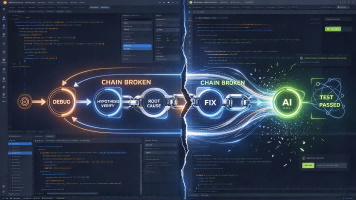
There used to be only one road from bug to fix: something breaks → form a hypothesis → test it → work out the full story → change the code → fixed. Fixing and understanding were never two activities; they were two steps on the same road, and you couldn’t skip either — because the entire road had to be traveled inside one human head.
AI built a second road: something breaks → throw the error and the code at AI → AI hands back a fix → tests pass → merge. Nowhere along that road does anyone need to understand anything. How does AI manage it? Not by understanding your system — by having seen so many systems that your bug almost certainly has a near-identical cousin somewhere in its training data. It can answer without understanding.
And that opens up a badly lopsided gap:
Fixing is getting cheaper by the day. Understanding hasn’t gotten cheaper at all.
Because understanding has one hard constraint AI still can’t get around: it can only grow inside a human head. AI can generate explanations, comments, documentation — but those are reference material, not something you know. A team’s total understanding of its system is, in the end, the sum of what’s in its people’s heads, and that sum doesn’t go up by a single gram just because AI can fix bugs.
In the past this was never a problem, because fix rate and understanding rate moved together: fix a hundred bugs, and you’d banked a hundred units of understanding along the way. That rope has snapped. Fix counts can climb forever while understanding stands still — or falls, because plenty of people no longer even read the fix AI hands them.
Let me give this kind of fix a name: the understanding-free fix. The bug is gone, but nobody ever worked out why it happened, why this fix works, or what else the fix might break.
Taken one at a time, each such fix is a victory for efficiency. The trouble starts when they accumulate.
3. The system runs better, and fewer people understand it
These fixes pile up quietly, and they corrode three places at once — each one disguised as good news.
The first is the team. On the surface, everything improves: bugs get fixed faster, incidents get resolved sooner, the stability graph looks great. But the understanding underneath that stability is quietly draining out of people’s heads. The system becomes something new under the sun: a machine that runs well and that nobody can read. Day to day it shows no symptoms, because every routine failure sits comfortably inside AI’s experience. Then one day a failure arrives that doesn’t — an unfamiliar race condition, an architectural cascade no textbook covers — and the team discovers it can neither locate the fault nor narrow it down with hard-won prior knowledge. The system’s resilience never actually improved; the risk was merely postponed. And the price of postponement is a vault of understanding emptied out.
The second is the juniors. The old growth path was legible: you started on null pointers, graduated to concurrency, and eventually to architectural-scale failures — each tier of bugs laying the foundation for the next. The whole point of the path was that it forced you to understand the system somewhere low-stakes. AI has knocked out the bottom rungs. New engineers now begin at “paste the error into AI” and skip the early accumulation entirely. Hence a paradox: this generation of newcomers ships more than anyone in history, yet judges the system worse than anyone in history. They’re not out of time to grow — the ladder they were supposed to climb has been dismantled.
The third is compounding — the quietest loss of the three. The insight you take away from fixing a bug was never just for that bug. Next time you design something, you remember: “I’ve stepped on this landmine before; route around it.” Those lessons settle into the team’s coding habits, into the depth you can summon in an interview. Human understanding pays compound interest: invest once, draw on it for decades. AI’s “understanding” lives in a session window; close the window and it’s gone. AI fixes a thousand bugs and the team’s understanding grows by zero; a person fixes a hundred and it pays dividends for twenty years. There was never a choice before, because only humans could fix things. Now there is one — and nearly every team is choosing the zero-interest option without realizing it.
Run the three together and you get a single test. Every time a fix lands, ask one question:
Who understands this system better because of this fix?
If the answer is a person — even a slow fix — you’ve added to the vault. If the answer is “nobody” (AI fixed it; a human clicked merge), then no matter how green the tests, the fix was just a payment, and the interest on it is charged to the team’s future.
4. The objections worth taking seriously
This argument invites some obvious pushback. Better to take it head-on than hope nobody notices.
“Doesn’t AI also explain code? You can still get understanding — just a different way of acquiring it.”
This is the strongest objection, and it deserves a longer answer.
The crux: understanding you can look up is not understanding you own. AI’s explanations are dictionary lookups — you ask, it answers, and the answer disperses. What actually serves you in an incident is the model that lives in your head unsummoned — the one that automatically throws off candidate hypotheses the moment something misbehaves.
You won’t notice the difference on quiet days; you’ll notice it in an incident. When you’re debugging something complex, the scarcest resource is the speed at which candidate hypotheses appear: facing a pile of vague symptoms, you need enough inventory in your head to list ten directions worth testing within minutes. There’s no time for a round trip with AI. More to the point, a model you never internalized cannot generate hypotheses for you. An engineer who has read a hundred AI explanations but never personally climbed one causal chain will, at the scene of a real incident, produce hypotheses an order of magnitude worse than a veteran’s.
A bigger dictionary doesn’t make you more literate. Looking up is not owning.
“So every fix goes back to pure manual labor? Isn’t that regression?”
Of course not. Bugs come in two breeds.
One is the familiar face: a well-known failure shape with a known cure, nowhere near the system’s deep structure. Hand those to AI and let it fix them sight unseen — that’s not just acceptable, it’s progress. Building a deep understanding of a null pointer was always a waste of a human’s time.
The other is the strange animal: eerie symptoms, a cause buried deep, tangled up with the system’s structure. For these, the act of fixing is the act of understanding; skipping it is skipping the lesson.
The real danger isn’t which kind AI fixes. It’s that telling the two apart is itself a task that requires understanding. You need enough inventory before you can tell a familiar face from a strange animal. And that judgment atrophies the way muscles do: feed every bug to AI long enough and your sorting instinct dulls, until you can no longer tell which bugs shouldn’t go to AI. At that point you’re in a loop: the more you lean on AI, the duller the instinct; the duller the instinct, the harder to tell what to keep; the harder to tell, the more you lean on AI.
“Hasn’t this decoupling happened before? Compilers spared us machine code; frameworks spared us the layers below. Why is this time different?”
Because every earlier decoupling removed muscle work, while understanding stayed on the human side of the line. A compiler means you don’t write assembly — but you still have to understand semantics and logic, or your higher-level code simply won’t work. A framework encapsulates the layers beneath — but its behavioral boundaries remain required reading for anyone who uses it. Technology has kept abstracting away layers of detail; the act of understanding itself never moved.
This time it moved. What AI does for you is precisely the act of understanding — not abstracting away one more layer of detail, but subcontracting the entire business of “read the system, find the cause, produce the fix.” What got outsourced isn’t any particular layer of knowledge; it’s the process of acquiring knowledge. That’s a first.
“Isn’t this just the ‘understanding debt’ from your last piece, rebranded?”
Not a rebrand — the other side of the same coin, and the two sides need separate accounting.
That piece was about the repository side: code nobody understands, with the debt booked against the system. This one is about the human side: fixes that no longer grow anyone, with the debt booked against the engineers’ heads. The same decoupling writes off a bad debt on both sides of the balance sheet. If you only see the repository, you’ll believe that having a human skim AI’s code in review settles the account. Ten minutes of review cannot settle the human side — that reviewer never went through hypothesis, verification, surprise, and the click of insight, and understanding comes only out of that process.
Once these four are absorbed, the claim comes into focus: the question is not whether AI should fix bugs. The question is that fixing and understanding have genuinely split apart, while nearly every mechanism this industry runs on — hiring, performance reviews, promotion, knowledge management — still assumes they’re married.
5. What to do: turn every fix back into a lesson
The split is irreversible; giving up is not. Since the market will no longer hand you the fix-for-understanding trade automatically, teams and individuals have to weld it back together themselves.
One: change the definition of “done” — from “tests pass” to “someone can narrate the causal chain.”
Acceptance used to mean the bug disappeared. Add a clause: why did this bug happen? Why does this fix work? What could this fix break? Someone must be able to answer without opening a reference. If they can’t, the fix isn’t done. That’s not ceremony — it’s reserving one station on the fix assembly line for understanding.
Two: after an AI fix, add a retelling step.
Whoever merges should explain it — to the team, or at minimum to themselves: what’s the full story of this bug? What did the AI change? Why there, and not somewhere else? Explaining is how looked-up understanding gets compressed into your own head. One honest retelling outlasts ten casual merges.
Three: capture the understanding before the session evaporates.
Close the window and it’s gone. So write it down while it’s still warm: a postmortem with actual content (not the checkbox kind), a why-comment at the fix site, a test that pins the bug shut, a note on which hypotheses were ruled out along the way. This is the previous piece’s principle landing right here: intent, constraints, and decision records are the real assets. AI can regenerate the code any time; only a human can turn a fleeting insight into something the team keeps in the vault.
Four: keep a manual lane for the strange animals.
Teams should draw two lanes explicitly: familiar faces take the AI fast lane — no understanding required, optimize for throughput; strange animals must be human-led with AI assisting — the understanding may not be outsourced. The lane looks slow in the short run; in the long run it’s insurance on the team’s judgment, a guarantee that someone has always lived through the full arc of a hard bug.
Five: debug by hand on a regular schedule.
For individuals: however good AI gets, now and then pick a problem and work it the old way — no answers from AI; raise your own hypotheses, run your own experiments, verify your own causes. That’s not nostalgia. Debugging is a textbook use-it-or-lose-it skill, and the moment it pays highest is precisely the incident AI can’t handle.
Six: change how you count output.
An engineer’s value is no longer “how many bugs did you fix” — that number will keep getting cheaper. The new arithmetic: how many causal chains can you narrate, how many constraints and lessons did you leave behind, how many people see the system more clearly because of you. A hundred fixes with no understanding left behind add up to zero; ten fixes, each turned into a shared model, are ten compounding assets.
6. A closing thought: the honest conversation with your system
Back to the bargain at the top: fix a bug, grow an inch.
Debugging used to be the only honest conversation between an engineer and a system. The system doesn’t flatter you and doesn’t follow your first guess; in every failure it forces you to drop your assumptions, face the evidence, and re-learn what it actually is. For decades, this thankless conversation is what forged newcomers into people who genuinely understand systems.
AI hasn’t canceled the conversation. It has simply added a new option: skip the conversation, copy the answer.
Do that often enough and you end up with a system at war with itself: it runs better and better while being understood less and less. Stability and comprehensibility have never before been free to move in opposite directions. And every disaster in engineering history points at the same truth: a system’s reliability is decided not by how well it runs, but by whether anyone knows why it stopped.
So one question deserves a serious answer from every engineer and every team:
Do you want a machine that runs well and that no one understands — or a system that keeps evolving because people do?
If it’s the latter, then the AI era has exactly one discipline that matters:
Never stop asking why in the places nobody understands.
Even if the bug’s already fixed. Especially then.