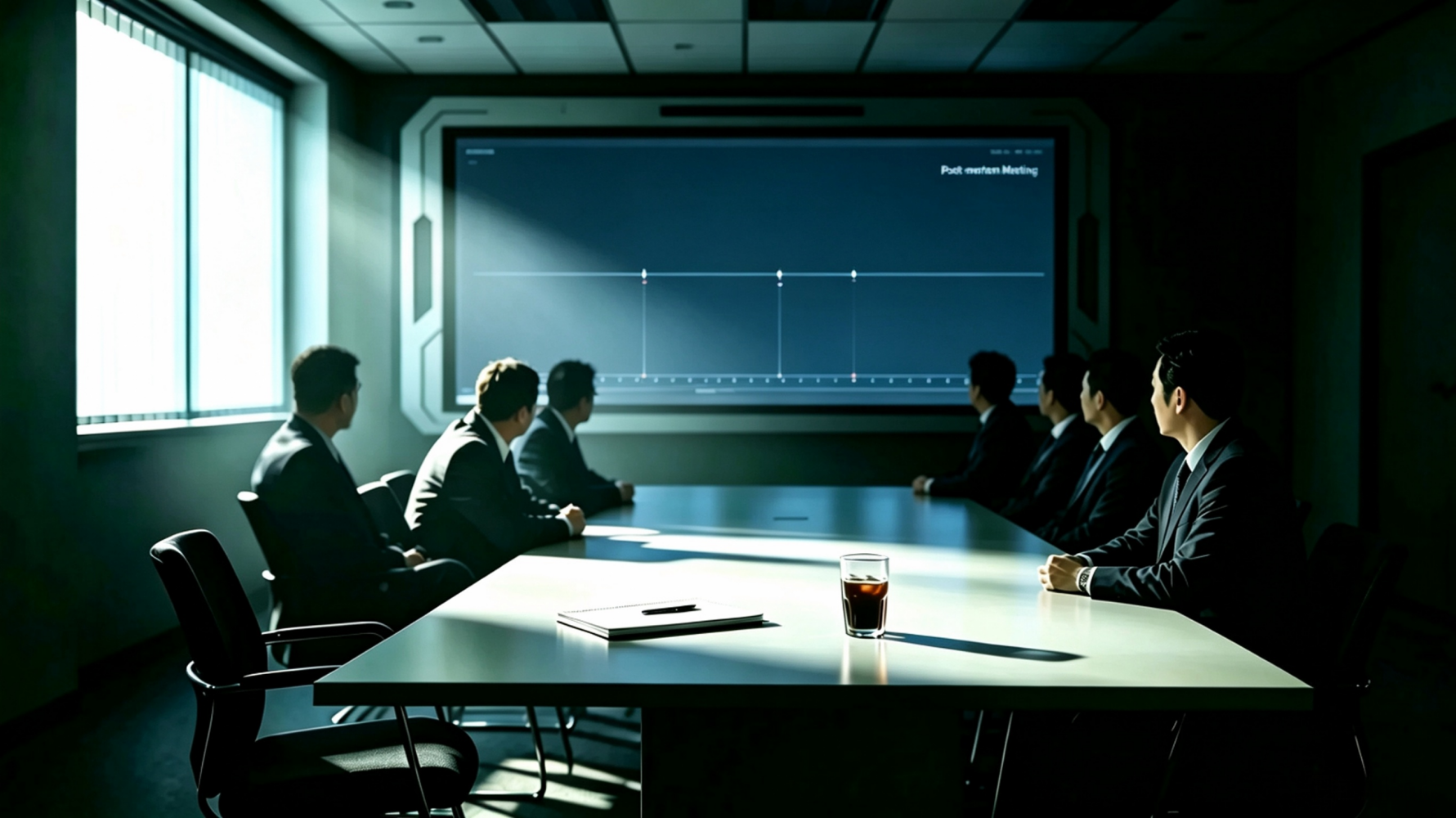
Three days after the incident, the system is quiet. The dashboards are green. The customer has been talked down. Seven or eight people sit in a conference room, looking at a timeline the facilitator stayed up all night to assemble.
The facilitator turns to the first page and asks the question almost every postmortem asks. “Who changed that config?”
The air in the room turns inside of two seconds. The people who had been walking the timeline look down at their phones. The person just named starts choosing words. A few others, who saw the problem and said nothing, feel a private relief. Good. It isn’t them.
The next forty minutes go to who should have seen the alert, why nobody stopped the decision, and whether someone failed a step in the process. The only thing the room can agree on is the sentence that closes every review of this kind: Be more careful next time.
If that sentence is all a postmortem carries out of the room, what got repaired is probably not the system. It is the script for the next incident report. Everyone will have learned to clear themselves a little earlier. This piece is about why a postmortem decays into a search for someone to blame, and about what a real one is actually investigating.
1. Blame and the review are fed the same evidence
An uncomfortable claim, up front. A postmortem turning into a blame session is not a slip in execution. It is close to inevitable.
After an incident, an organization has two jobs to do, and those two jobs are fed the same material and pointed at opposite ends.
The first job is blame. It answers “whose fault was this.” It faces backward. Its purpose is to assign responsibility, settle the feeling in the room, and hand management a line they can repeat. Blame is a psychological need. Something large went wrong, so someone has to pay, or the whole organization will feel the thing was simply allowed to pass.
The second job is the postmortem. It answers “why did the system permit this.” It faces forward. Its purpose is to repair the structure, thicken the defenses, and keep this class of incident from coming back. A postmortem is an engineering need. An incident is the way a system exposes a weakness. The review is the way you take that signal in.
The trouble is that the raw material is identical: the timeline, the chat logs, the diffs, the decisions. So the organization quite naturally tries to do both jobs in one meeting. The evidence is already on the table. Why book the room twice?
The two purposes exclude each other at the level of method. The moment blame goes first, nobody’s first move is to reconstruct what happened. It is to adjust their own place in the story. Memory becomes negotiable. “I think I did send a message.” “That email never reached me.” “I raised this risk, and nobody took it up.” Each account bends, slightly, in the speaker’s favor. This is not lying. It is what people do under pressure.
A postmortem lives or dies on its chain of evidence. The same point is the whole of Heap Corruption Forensics: the crash site is not the crime scene, and once the scene has been walked over, the truth does not come back. In a review, the trampling is edited memory. Once a statement starts serving self-protection, every piece of material that review is holding has already been contaminated.
This is why so many organizations run postmortems year after year while the same class of incident returns year after year. Not because they are careless. Because from the first minute, the process is systematically collecting distorted evidence. Repair a system with contaminated evidence and what you get back is the same system.
2. Once you know the ending, every mistake looks stupid
One more thing that shows up in almost every review: the moment the cause is named, everyone in the room feels that a problem this obvious should have been caught at the time.
Cognitive science has a name for it. Hindsight bias. Once you know the outcome, your mind quietly rebuilds a causal chain in which the incident was foreseeable all along. Looking back, that null check was obviously defensive. Looking back, that alert obviously should have been paged. Looking back, that rollout obviously should not have gone to everyone.
Looking back is the problem. The reviewer’s view is full of information the person at the time could not have had, and that information makes every wrong decision look foolish. “How did nobody see this” slides, without anyone noticing, into “how could anyone be this careless.” The investigation turns toward intelligence and attitude, and away from the shape of the system.
Which brings up the first principle of a blameless postmortem. Call it local rationality:
Inside the context they actually had, nearly every decision the person made was a reasonable one — reasonable, at least, within the information they could see.
This is not a moral posture, and it is not “go easy on the new hire.” It is a working hypothesis, and it works like this. You assume the person made the best choice available inside their field of view, and then you investigate why their field of view had that shape. Why couldn’t they see the alert? Why did nobody stop the change? Why did “wait before going fully live” look, at that moment, like an unnecessary delay?
Follow that thread and you find a whole structure standing behind every incident. Who set the alert threshold. Whether the on-call runbook mentions this case at all. How many other changes the reviewer was already holding that day. Whether the “human confirmation” in the rollout is a person actually looking, or a checkbox on the way past. A person’s mistake works like developer fluid on film. It does not put the hole there. It makes a hole that was already there visible. Every “how could anyone get this wrong” is a precise reading of where the system is empty.
This is also the deepest rhyme between debugging and a postmortem. The first lesson of debugging is that the crash site is not the crime scene. The first lesson of a postmortem is the same sentence, turned around: the person who erred is not the scene of the failure. The process is. A debugger does not patch line A just because the process died there. They first find out how the memory was corrupted. A reviewer should not answer a mistake at step X with “more training.” They should first find out how the system let that mistake walk all the way into production.
3. “Blameless” is not mercy. It is a discipline.
The first reaction most people have to a blameless postmortem is: if nobody is held responsible when something breaks, isn’t that just letting it go?
The question treats “blameless” as a moral choice, a soft compromise between blame and forgiveness. The real meaning sits at the level of method. Blameless does not mean you decline to follow responsibility. It means you refuse to let the investigation stop at a person.
One test separates the two. Every postmortem report should be able to answer this:
If you had swapped in someone more senior and more careful, would the incident still have happened?
If the answer is yes, the problem lives in the structure. Replacing the person only replaces the unlucky coordinate. The hole is still there, and the next person to walk into it will be someone else. If the answer is no — and this case is rarer than it feels — then a conversation about the individual is worth having. It usually doesn’t go far. “Find a person who never makes a mistake” has never been an action item anyone can carry out.
The Swiss cheese model says it plainly. Every serious incident is several layers of defense failing at once. Review didn’t catch it, tests didn’t cover it, the staged rollout didn’t trip, monitoring didn’t page. Each layer, taken alone, has an excuse. Stacked, they are a disaster. What the postmortem has to investigate is the stack itself: why did five or six layers of defense fail to stop a single thing? The answer to that question always lives in the structure. A defense fails because of how it was organized, not because the person standing on it had an off day.
So blameless is not mercy. It is the stricter discipline. It forbids you the easiest way out of the room — pinning it on one person — and forces the investigation down into the structure. A blame meeting can reach its conclusion in ten minutes. It was the person who changed the config. A blameless postmortem may take three weeks to walk five layers of defense one by one. The first is cheap, and it does nothing. The second is expensive, and it is the only one that works.
One clarification belongs here. Blameless is not the same as consequence-free. A process can be changed. A permission can be narrowed. A team that keeps losing the same ground will see its own action items go overdue. The consequence lands on the structure, and on the duties attached to a role, rather than on who carries the blame. The difference is not severity. It is direction. Blame aims the consequence at the past. The review aims it at the future.
4. A postmortem you can actually run
Principles are cheap. At the level of the meeting, a postmortem that holds together is roughly four steps. The order matters. Doing them out of order is the usual way a review gives way.
First, rebuild the timeline from records, and keep memory out of it.
The timeline is built only from things that were written down at the time: graphs, alerts, change logs, chat, the audit trail. The rule is simple. Anywhere you have a witness and no record, mark it unverified, and do not treat it as fact. This is the same move as reproduction and observation in debugging. Without a reliable record of what happened, everything you build afterward is a house on sand.
Second, mark the decision points, and restore the context they were made in.
Every moment on the timeline where a person chose — chose to ignore an alert, chose to skip a test, chose to ship to everyone and sort it out after — gets pulled out on its own, and three questions get answered. What did they know? What could they not see? How much time did they have? This is local rationality made operational. The question is not why they were careless. It is why their field of view had that shape.
Third, walk the defenses backward.
Start from the failure and go back up the line. Why didn’t monitoring warn earlier? Why didn’t the staged rollout stop it? Why didn’t review find it? Why were the tests green? Each layer has to answer why it failed, not who is at fault that it failed. What you usually find is that the failures repeat. Several layers died for the same reason: the check depended on a particular person being present, and that day they were not. That repeated pattern is the real target of the fix.
Fourth, write the actions, and be honest about “less often” versus “never again.”
An action has to aim at the structure rather than a person, and it needs an owner and a date. More important than either is honesty about the action itself. Most of them can push an incident from once a quarter to once every two years. Very few can make it impossible. A report packed with promises to eliminate a class of failure forever is usually not repairing the system. It is striking a pose.
One thing sits outside all four steps and decides whether any of them work. The real product of a postmortem is not the action list. It is trust. The next time something breaks at three in the morning, will the person on call say the first sentence straight — “I changed the config, and then I saw it was wrong,” rather than “the system did this on its own”; “I approved that logic without really understanding it”? Whether they dare is the whole of what every previous review has left in them.
5. The model is in the meeting. It cannot take the stand.
A blameless postmortem is already hard in a team made entirely of people. AI knocks out one of the premises it stands on.
The activity quietly assumes something it never states. Behind every action in the system is a person who can be called into the room, questioned, and held to account. That premise holds up the logic of blame, and it holds up the logic of improvement too. Action items, in the end, are carried out by people.
AI puts a hole straight through it. Production incidents now arrive along a chain like this more and more often. The failing code was written by a model. The reviewer didn’t fully understand it, but it read convincingly, so they approved it. The live mitigation was whatever the model suggested. Then the incident happens, and the postmortem convenes.
The “author” of the code cannot attend. It has no memory to edit, no feelings to soothe, and nothing it will hide out of fear. It also learns nothing from the incident. Next time, handed the same context, it will very likely write the same code. A person in the room can be taught by a postmortem. A model cannot. Who is the write-up even for?
What remains to be blamed is the person who signed. Look closely at that position. They signed something they had not fully understood. They know a review is supposed to be real understanding. The volume of generated code is too large, and the style too unfamiliar, for a line-by-line reading to fit in the schedule, so “review” thins out into spot checks plus trust. That was local rationality at the time. You cannot ask someone to read ten times the old volume of code at the pace they used to read a human author’s.
The postmortem has run into a structural problem it has not had before, and it is the judgment in Fixing No Longer Produces Understanding, cast at the level of the organization. Fixing no longer produces understanding, and review no longer produces it either. Once the signature and the understanding come apart, blame loses half its point. You can punish the person who signed. They couldn’t read it at the moment they signed, and punishing them does nothing about the next unread approval.
So a postmortem in the age of AI has to dig one layer further down. The old question was whose fault. Blameless practice changed it to which structure. The AI era adds one more:
In our process, which steps does no person actually understand while they are happening?
Is review still a review? Is the alert runbook still something a person can carry out? How many decisions on the critical path are a suggestion from a model followed by a human nod? The answer to that question draws a circle around where the next incident will start.
6. What the organization is willing to trade
A postmortem, in the end, answers one question. For this incident, what is the organization willing to trade?
Blame’s answer is a person. It costs the least, it lands the fastest, and it is the most satisfying thing in the room. The price is a contaminated chain of evidence, a structure left exactly as it was, and the next incident waiting somewhere else.
The review’s answer is the truth. It asks everyone, under pressure, to hand over memory they have not tidied. It asks the organization to admit that its defenses were empty, layer after layer. It asks management to look at engineering work that is painful to pay for, and to approve the budget anyway.
The first is an instinct. The second is an engineering choice.
The quality of a postmortem was never decided by what the meeting concluded. It is decided afterward, when people are back at their desks, by what they now expect the first sentence of the next incident to sound like.
A postmortem never repairs the failure that already happened. It repairs the nerve to speak plainly at three in the morning, the next time.